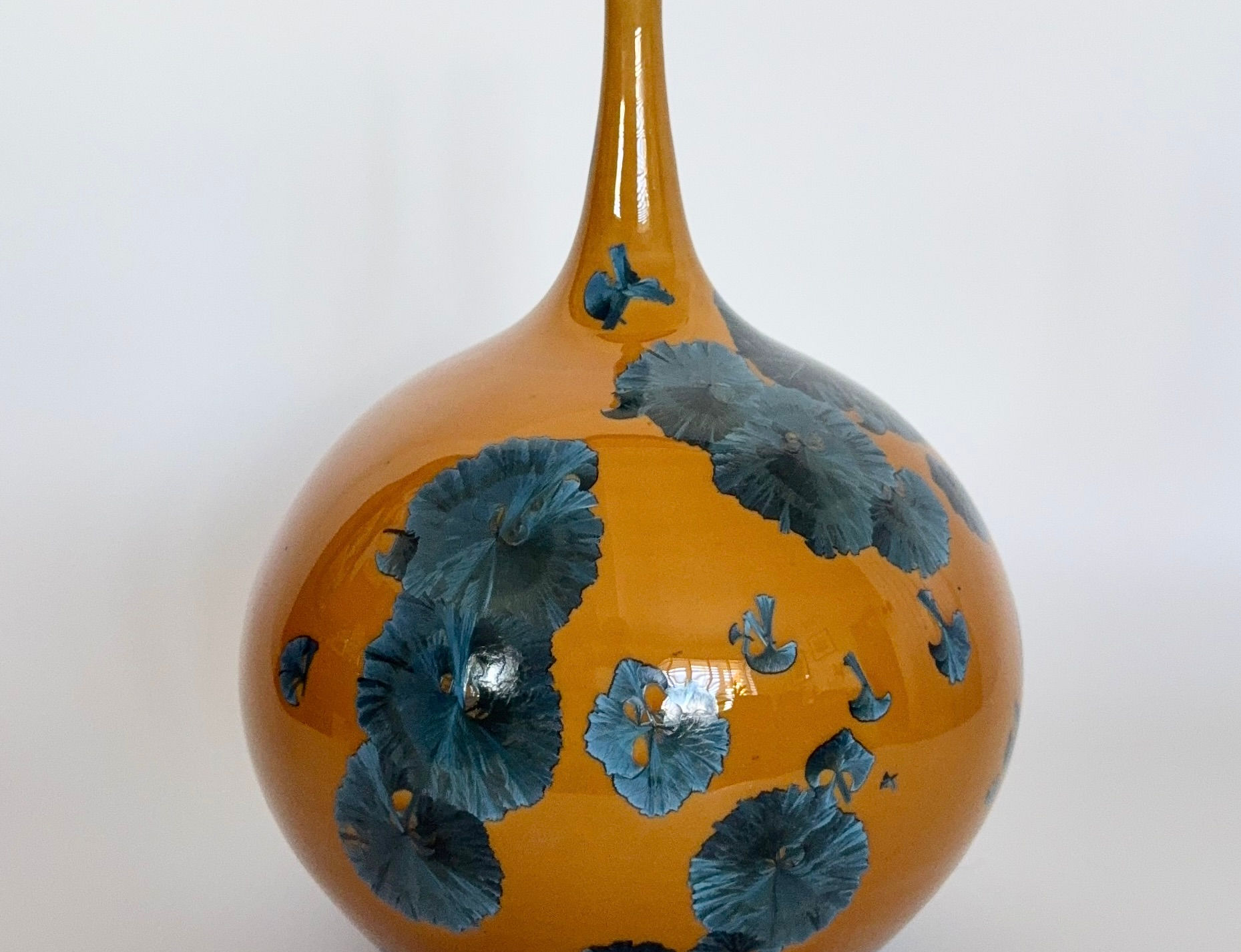
Clay Bodies & Crystalline Glazes
Many crystalline potters agree that porcelain is the ideal clay for crafting crystalline glazed pottery, and this is largely accurate. Porcelain's smooth texture contributes to a flat, scratch-free surface after bisque firing. Moreover, its low iron content facilitates crystal formation during firing. However, the main challenge with porcelain is its difficulty when throwing on the potter's wheel. Those who have attempted it are familiar with the challenge, but with patience and practice, these issues can be surmounted.

I work with a porcelain body called Audrey Blackburn, designed for wheel throwing. While it's not as easy to throw as stoneware, it performs better than many other porcelain bodies available today. I like to use porcelain when it's a bit firmer than usual, so I typically let it sit for a few hours after pugging. I've discovered that instead of using water while throwing, a slip made from porcelain slop helps prevent pieces from slumping too quickly. Nonetheless, it's beneficial to use as little slip as possible and to throw relatively quickly.
While working with porcelain pieces around 10 to 12 inches tall is achievable, I prefer creating much taller works, which is where I encounter challenges. I am always impressed by Korean potters who throw large pieces using porcelain. However, I suspect that the porcelain they use is somewhat more suitable for throwing than what is typically used in Europe.

I have identified a few solutions to the problem. Initially, I realized that mixing porcelain with a smooth white stoneware body in equal parts (50/50) greatly improves my capacity to achieve increased height and size. It is essential to wedge the two clays thoroughly until they attain a consistent texture and color. By using this technique, I have been able to throw pieces over 18 to 20 inches tall and noticed that when glazed, well-spaced crystals can be achieved.
The alternative approach is to utilize a high-quality smooth white stoneware body independently. Once it is completely dry, apply a thin layer of pure porcelain slip. In my experience, mixing a porcelain powdered body into a relatively thin slip and then spraying it with one or two coats allows the fired work to develop crystals.
Admittedly, utilizing a smooth white stoneware base and then applying a porcelain spray makes the process significantly more complex. It would be much easier to refine my skills using pure porcelain. However, it's challenging to change established habits, so I embrace the added complexities to facilitate the creation of large pieces.
I hope this has been useful......good luck!


Comments