Life of a Crystalline Potter in Farthingstone Crafting Unique Ceramic Art
There is a particular kind of silence in a pottery workshop when the kiln is cooling. Nothing useful can be done. The work has been mixed, thrown, trimmed, glazed, loaded and fired. The crystals have either grown or they have not. All that remains is to wait.
In a small workshop in Farthingstone, Northamptonshire, that waiting is part of the rhythm of life. The shelves hold bowls, vases, lidded forms and smaller functional pieces, each one made by hand and each one carrying the risk of crystalline glazing. Some will emerge with bright, floating blooms across their surface. Some will be quiet and subtle. A few will be disappointing. Now and then, one will be outstanding.
That uncertainty is both the attraction and the torment of crystalline ceramics. It is not a process built for repetition. It is slow, technical and often unforgiving. Yet when it works, it produces ceramic art with a depth and individuality that is hard to find anywhere else.

A quiet workshop with a demanding craft
Farthingstone is the kind of Northamptonshire village where craft can still feel connected to place. The pace suits pottery. Clay needs time. Glazes need patience. Kilns cannot be rushed. A small workshop gives enough room for focus, but not enough room for waste. Every shelf, container and firing space matters.
A crystalline potter’s day is practical before it becomes poetic. There is clay to prepare, dust to control, tools to clean and test tiles to label. Forms need to be planned with the glaze in mind. Crystalline glazes do not behave like ordinary glazes, so the shape of the pot matters.
A vase with a broad shoulder may encourage crystals to gather and spread across the surface. A simple bowl may show the glaze beautifully, but it may also run heavily during firing. A tall form can create drama, with crystals suspended like flowers or frost. The potter has to think ahead, not only about the shape in clay, but about what the molten glaze may do later in the kiln.
That is part of the appeal. Each piece begins as a controlled object, centred on the wheel and shaped by hand. Later, the firing introduces chance. The finished work sits somewhere between planning and surprise.
What makes crystalline glazes so different
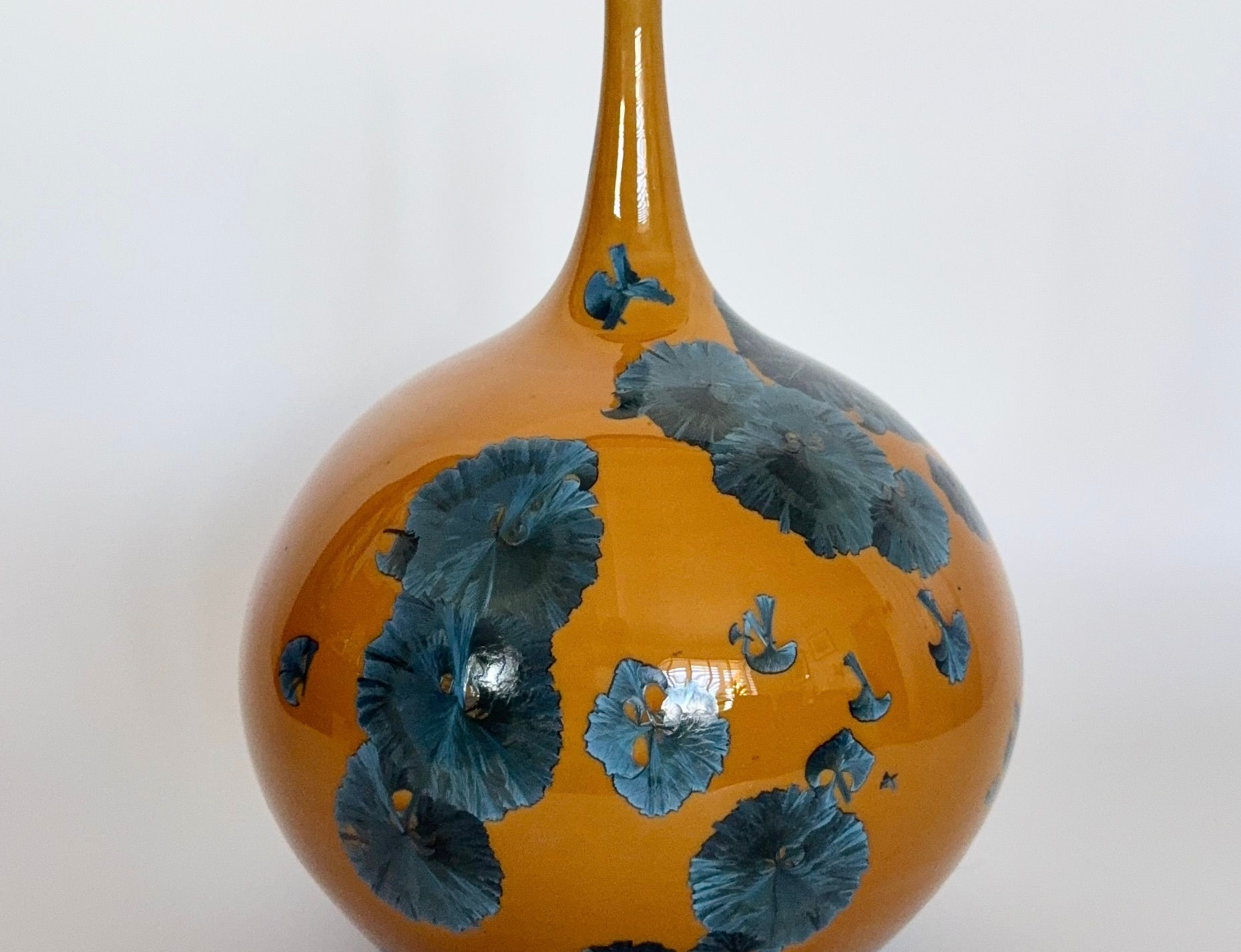
Crystalline glazing is one of the more unusual branches of studio ceramics. The surface is not painted with crystal shapes. The crystals grow inside the glaze during the firing.
The glaze usually contains ingredients that encourage crystal formation when the kiln reaches a high temperature and then holds at carefully chosen lower temperatures. During those holds, crystals can develop in the molten glaze. Their size, shape and arrangement depend on the glaze recipe, the firing schedule, the form of the pot and the conditions inside the kiln.
That sounds simple when written down. In practice, it can feel like trying to guide weather.
The glaze must become fluid enough for crystals to grow, which means it often runs. Pots may need special catchers or saucers beneath them to collect excess glaze. After firing, those catchers have to be removed and the foot of the pot ground smooth. If too little glaze moves, the crystals may be small or dull. If too much moves, the piece may be damaged or stuck fast.
Small changes can have large effects. A slight difference in thickness, a small variation in the glaze mix or a shift in the firing cycle can change the result. The same recipe can produce a calm field of small crystals one week and dramatic, open blooms the next.
For the potter, that makes the work deeply absorbing. Crystalline glazing rewards knowledge, but it never gives complete control.
The careful work of mixing glazes
Before any kiln is loaded, the glaze has to be mixed. This is one of the least glamorous parts of the process, but it is one of the most important.
Glaze materials must be weighed carefully. The order of mixing, the sieve used, the amount of water and the final consistency all affect how the glaze applies to the pot. Too thin, and the surface may lack depth. Too thick, and the glaze may run beyond what the catcher can handle. Poorly mixed glaze can leave uneven surfaces, bare patches or unwanted textures.
A crystalline potter soon learns that care in the glaze room is not optional. It is where success often begins.
There is also the need for records. A potter may note:
The clay body used
The exact glaze recipe
How thickly the glaze was applied
The firing schedule
The position of the pot in the kiln
The result after firing
These notes build into a kind of personal map. They do not remove uncertainty, but they make the uncertainty easier to understand. If a firing produces a wonderful piece, the notes help the potter work towards that effect again. If a firing fails, the notes help explain why.
Even then, repetition is never guaranteed. That is why each crystalline piece is a one-off. It may belong to a family of related colours or forms, but its surface will not be exactly repeated.
The kiln is where hope and frustration meet
Loading a crystalline firing is a careful act. Pots need space around them. Catchers must be secure. The kiln shelves need protection. Each piece has to sit correctly, because the glaze will move when it becomes molten.
Then the firing begins.
The kiln climbs to a high temperature. At the right point, the potter must bring it down to the crystal-growing range and hold it there. Some firings involve several holds at different temperatures to encourage different crystal sizes. The firing arrangement can be demanding, and it asks for precision. A kiln is not just a hot box. It is the place where all previous choices are tested.
The most difficult part comes afterwards. The kiln must cool enough to open safely. Opening too soon risks damage and thermal shock. Opening too late prolongs the suspense, but potters are used to that. Waiting is part of the craft.
When the lid finally opens, the reaction can be immediate. Sometimes a piece catches the light at once, and the crystals seem to float over the surface. Sometimes the colour is better than expected. Sometimes the crystals have gathered in just the right place, giving the form energy and balance.
Other times, the disappointment is sharp. A glaze may have run too far. Crystals may be sparse. A promising form may look flat. A crack may appear. A pot may be technically sound but lack the spark that makes it special.
That is the honest life of a crystalline potter. There are no guaranteed masterpieces. There is only skill, attention and the willingness to try again.

The rare joy of an outstanding piece
The difficult firings make the successful pieces more meaningful. When a crystalline pot comes out well, it has a presence that feels both natural and designed. The crystals may look like snowflakes, flowers, sea forms or minerals seen under magnification. They have an organic quality, yet they appear on a vessel shaped by human hands.
An outstanding piece often has more than technical success. The form, colour and crystal placement all work together. A cluster of crystals might follow the shoulder of a vase. A quiet area of glaze might give the eye somewhere to rest. A strong colour shift might make the whole piece feel alive.
These are the moments that keep the potter returning to the kiln.
There is a particular satisfaction in knowing how much had to go right. The clay had to survive. The glaze had to be mixed well. The firing had to reach the right points. The cooling had to protect the piece. The crystals had to grow with character. The final grinding and finishing had to be clean.
When all of that comes together, the result feels earned.
Decorative art that can still be functional
Crystalline ceramics often appeal to collectors because they are rare, complex and visibly individual. No two pieces share the same crystal pattern. This gives them a natural place in collections of contemporary craft and fine art ceramics.
Yet not every piece has to sit behind glass. Part of the pleasure of handmade ceramics is touch. A crystalline bowl, vase or lidded pot can bring art into daily life. Some pieces are mainly decorative, made to be looked at and enjoyed for their surface. Others can be functional, depending on their form, glaze and intended use.
That balance between decorative and functional work matters. A vase can hold flowers and still be a piece of ceramic art. A bowl can sit on a table and change with the light throughout the day. A small vessel can invite close looking from every angle.
For lovers of special fine art, crystalline pottery has a quiet kind of luxury. It does not depend on precious metals or grand scale. Its value lies in rarity, skill and the strange beauty of a process that cannot be fully commanded.
Why collectors are drawn to crystalline pottery
Collectors often look for work that carries evidence of the maker’s hand. Crystalline ceramics offer that, but they also offer evidence of the kiln. The final surface records heat, timing, chemistry and chance.
That makes each piece feel like an event as much as an object.
Several qualities make crystalline work especially appealing:
Individuality
Each firing creates a surface that cannot be copied exactly.
Technical difficulty
The viewer may not know every detail of the process, but the depth of the glaze often suggests the complexity behind it.
Visual richness
Crystals can appear suspended within the glaze rather than sitting on top of it.
Connection to place and maker
A pot from a small Northamptonshire workshop carries a different feeling from mass-produced ceramic ware.
A mix of control and chance
The work shows both discipline and unpredictability.
For collectors, that combination is powerful. It gives the object a story, not in a forced way, but through the way it was made.
The emotional rhythm of the work
The life of a crystalline potter is not only about technique. It is also about temperament.
The work asks for patience after failure. It asks for care when no one is watching. It asks the maker to repeat simple tasks with precision, even when the last firing was discouraging. It requires a strange mix of confidence and humility.
Confidence is needed to keep making. Humility is needed because the kiln will always have the final word.
There are days when the process feels too demanding. A glaze that worked before may disappoint. A firing may produce little worth keeping. Hours of preparation may end in pieces that need to be broken, recycled or set aside as lessons rather than successes.
Then one pot appears that changes the mood of the whole week.
It may be a vase with crystals placed so well they seem intentional. It may be a bowl with a soft field of colour that could not have been planned in detail. It may be a small piece that carries more beauty than expected.
Those moments are the reward. They do not erase the frustration, but they make sense of it.
A rare craft sustained by patience
Crystalline pottery is rare because it is demanding. It takes space, time, materials, testing and a willingness to accept loss. It does not suit a production line. It does not offer easy certainty. For a small workshop, every firing carries real weight.
That rarity is also what makes the work special. In Farthingstone, the potter’s practice becomes a steady conversation between clay, glaze and kiln. The maker shapes the form, prepares the surface and sets the conditions. The crystals do the rest.
The best pieces feel alive because they come from that tension. They are not random, but they are not fully predictable either. They show what can happen when careful craft leaves room for wonder.
For anyone who values handmade ceramic art, the appeal is clear. A crystalline pot is more than a vessel with a beautiful glaze. It is the result of risk, patience and repeated return to a difficult process. It carries the marks of frustration as much as success.
And when the kiln opens on an outstanding piece, all the waiting feels worthwhile.


Comments