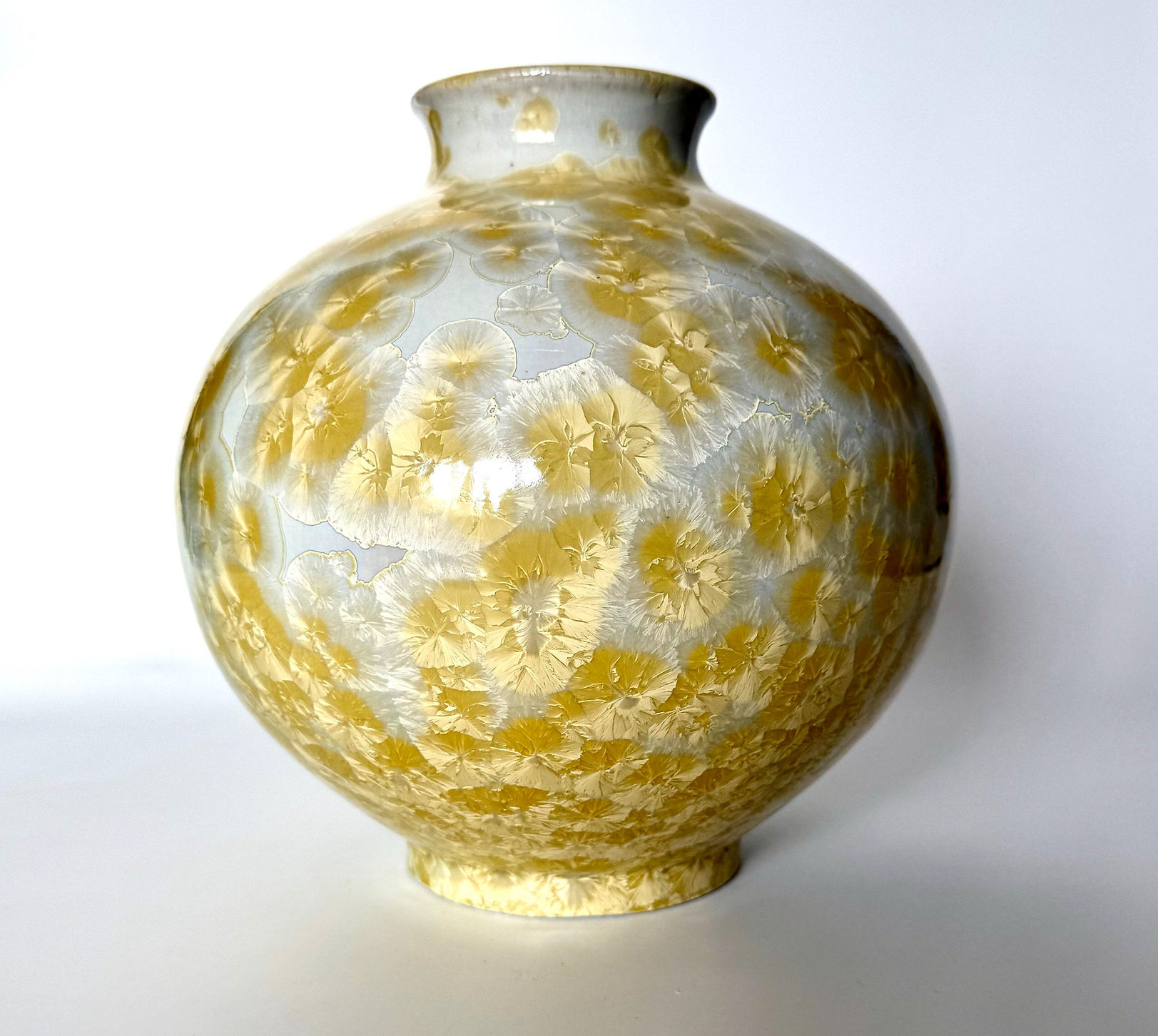
Mixing and Applying Crystalline Glazes
- Patrick Geenty
- May 27
- 2 min read
I thought it might be useful if I gave you a brief overview of how I prepare my pots for crystalline glazing. One of the most important factors is the clay body. Most crystalline potters recommend using a pure porcelain body as this gives the best crystal growth and I have tried using several types. However,I still find it very difficult to throw large, tall shapes because porcelain is a very difficult clay to use. I have found that a 50% mix of porcelain and a smooth white stoneware gives me the best of both worlds. It throws easily, enabling large and tall forms whilst still giving a surface that will allow crystals to form.
The surface of the thrown forms need to be as smooth as possible so I always refine the form with careful turning and then smooth the surface with a fine metal rib. This produces an almost burnished finish. Avoid grog at all costs. I also like to give the pieces a fine coat of sprayed white porcelain slip which just ensures that the surface is free from throwing lines and ready for bisc firing. Bisc firing to about 1020 degrees centigrade produces a surface that is porous and ready for glazing.
The next step is mixing the glaze. There are literally hundreds of crystalline base glazes which you can find on the internet but one of my most reliable recipes is:
Ferro Frit 3110. 490g
Zinc Oxide. 246
Quartz. 188
Titanium Diox. 70
Bentonite. 10
CMC. 10
I use a tall food blender and add the powdered ingredients one at a time, having carefully weighed each to the exact gram on a three beam balance. I add about 600 ltr of water to the blender, then blitz the mix for a couple of minutes until a smooth double cream mixture is obtained. The mix is then sieved through a 100 mesh sieve.
I always prefer to brush the mixture onto the pot in two or three layers. Letting each layer dry before applying the next. The brushed glaze should be thicker at the top, about 2 to 3 mm going down to 1mm at the base. The glaze will run considerably during firing hence the need to attach a catch bowl to the foot of the pot. I tend to throw one piece catch bowls that are the exact diameter of the pots base. I apply a thin bead of glue to the foot ring. The glue is a simple 50% china Clay and 50% Alumina Hydrate with a few drops of water and PVA glue to get the mix to a thick cream.
All my crystalline pottery is fired to cone 9 (about 1270 degrees centigrade) followed by a fast drop to 1100 degrees centigrade and then a hold for about 2 or 3 hours. There are a number of firing schedules which will produce different shapes and quantities of crystal formations and you will need to experiment to find one which suits your circumstances, Hope this has been helpful.


Comments